
顺丰
PLA Southern Theater Command tracks, monitors and warns 3 Philippine aircraft after their illegal entry into Huangyan Dao airspace_我的网站

A |

On Friday, three small Philippine aircraft - an Islander, a C-208, and a PA-31T - illegally intruded into China's territorial airspace over Huangyan Dao without approval from the Chinese government. The naval and air forces dispatched by the PLA Southern Theater Command (STC) tracked and monitored the Philippine aircraft, and issued verbal warnings to them in accordance with laws and regulations, senior Colonel Li Jianjian, spokesperson for the PLA STC Air Force, said in a statement on Friday.
The acts of the Philippine side seriously violate China's sovereignty, and are highly likely to cause misunderstanding and miscalculation. "We sternly warn the Philippine side to stop rights-violation and provocative acts immediately. Forces of the STC remain on high alert at all times to firmly safeguard national sovereignty and security as well as regional peace and stability," said the spokesperson.
Ding Duo, director of the Research Center for International and Regional Issues at the National Institute for South China Sea Studies, called the Philippines' latest move another "stunt."
The Philippines previously submitted its so-called "territorial sea baselines" around Huangyan Dao, so it is not unexpected that Manila would follow up with actions at sea or in the air to stir up tensions, keep the issue in the spotlight and stage further provocations, said Ding.
At present, the Philippines can barely gain access to the relevant waters and has secured no tangible advantage there. Aircraft, however, can enter and leave the area quickly. Such operations not only provide material for media hype but also generate footage of China's response, allowing Manila to project resolve and reassure its military and law-enforcement forces at home, Ding told the Global Times.
In late July, the Philippines notified the United Nations of the so-called "baselines and maritime zones" surrounding Huangyan Dao. On July 31, the Chinese Foreign Ministry issued a statement on the Philippines' delimitation of the so-called "baselines of the territorial sea" around Huangyan Dao, calling the move "a grave infringement upon China's territorial sovereignty and a serious violation of international law."
"It is illegal, null and void. China firmly rejects and will never accept it," the statement said.
Meanwhile, Manila appears emboldened by growing security and defense cooperation with the US and Japan. Backed by these external partners, the Philippines has shown greater willingness to stage provocations, while its military and law-enforcement forces have displayed increasingly risk-prone and opportunistic behavior, said Ding.
China has exercised considerable restraint over the Huangyan Dao, but the Philippines should not mistake that restraint for weakness. If China were to employ the full range of available measures, Philippine aircraft would likewise be denied access to the area, said Ding.
By dispatching small aircraft for deliberate provocations, the Philippines is further increasing the risk of miscalculation. Such aerial incursions are highly unpredictable and carry serious escalation risks. If China responds with resolute or more forceful measures to defend its rights and an unintended incident occurs as a result, the Philippines should bear full responsibility for the consequences, the expert warned.
。
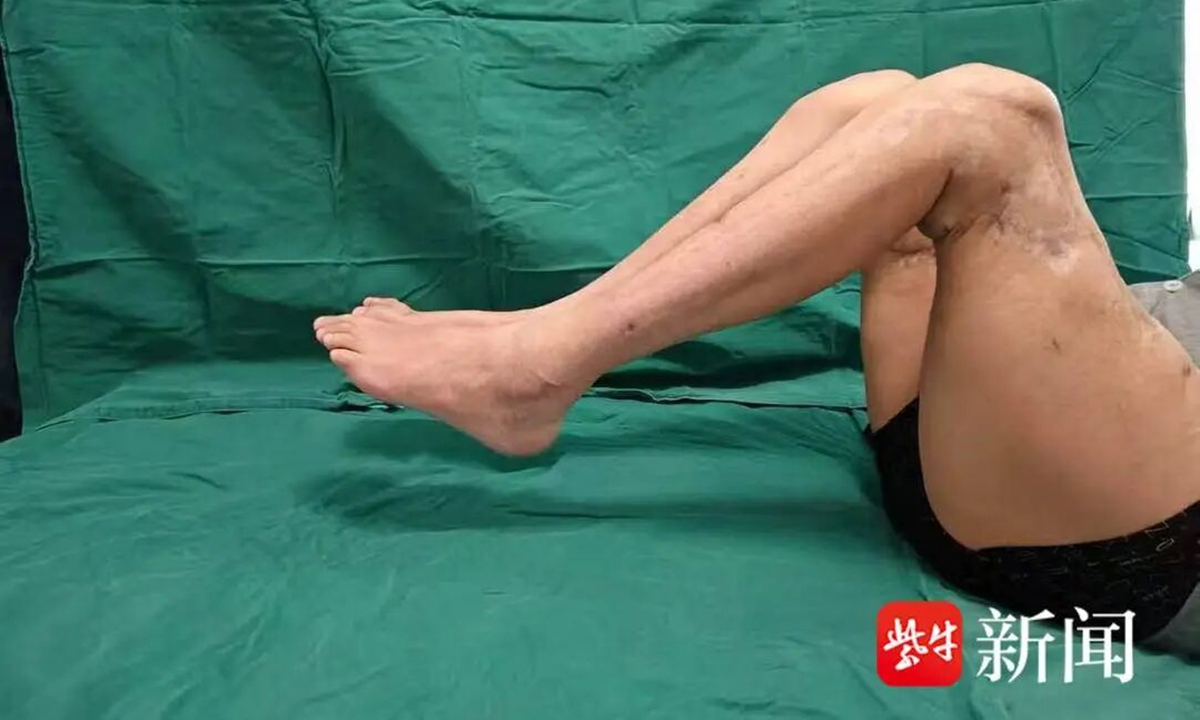
The patient, a 51-year-old surnamed Jiang, had both legs completely severed at the thighs in a machinery accident at a factory on December 2, 2024. A multidisciplinary team from the trauma orthopedics and joint surgery departments at Suzhou Ruihua Orthopedic Hospital, in East China's Jiangsu Province, worked through the night for nearly eight hours to reattach the two limbs, the report said.
Li Changsong, head of a trauma orthopedics team at the hospital, told the Yangtze Evening Post on Tuesday that Jiang can now walk indoors with a walker and manage most daily activities without assistance. Sensation in his lower limbs has also recovered to the area above his ankles.
"He is still recovering and is expected to gradually stop using crutches and eventually walk independently," Li was quoted as saying by the Yangtze Evening Post on Wednesday.
In March last year, shortly after the external fixators were removed from both legs, Jiang could already lift his legs freely while lying in bed. Sensation had returned as far down as the middle of his lower legs, and he was discharged from the hospital on March 5. His main goal at the time was to stand and walk again through rehabilitation, according to the report.
More than a year later, Jiang has moved from being confined to bed to lifting his legs and then standing and walking, the report said, noting that his rehabilitation is still ongoing.
The recovery process has not been without complications. Jiang developed localized skin necrosis after the operation and underwent flap reconstruction surgeries. He later required bone grafting and reinforced internal fixation of both femurs after severe open comminuted fractures resulted in femoral nonunion.
Li said Jiang is now in good overall condition, with his legs approximately equal in length.
"A novelty assessment conducted by the Jiangsu Institute of Medical Information confirmed this as the world's first case of replantation following the complete severing of both thighs," Li said.
Li said the case was considered a world first primarily because both legs were completely severed at thigh level simultaneously, an extremely rare injury. The hospital had previously accumulated extensive experience in replanting single limbs and lower legs, while its expertise in fracture fixation, vascular anastomosis and nerve repair provided an important technical foundation for the operation, according to the report.
Li did not give a timetable for when Jiang might be able to stop using a walker completely.
"Recovery varies from person to person. We still need to monitor his muscle strength, nerve sensation and fracture healing," Li said. Based on his current progress, however, Jiang's walking ability could continue to improve, the Yangtze Evening Post reported.
Global Times
。
Current article:http://d22.shengyaodanrongchui.buzz/news/20260826_72541.html
Published on:07:14:30
我的网站最近更新
- 央行授权德意志银行担任法兰克福人民币清算行
- iPhone 17 सीरीज लॉन्च से पहले iPhone 16 Pro Max पर डिस्काउंट, मिस न करें ये Deal
- 连轰607分!墨菲打破奥沙利文尘封12年纪录
- 曝赛豆AIVA或将采用宁德时 代换电方案 首款量产车ME7年内亮相
- 腾讯亮剑、字节缺席,AI共识变了
- 【风口研报】10家派现近170亿!板块估值处历史低位 证券行业有望迎估值修复窗口
- 人老房老设施老 物业服务怎么搞?桐庐想了个好办法
- 德天空:如果卢克巴留队,明夏解约金条款将降至6500万欧元
- Salman Khan to Work With South Director Vamsi Paidipally
- 李想官宣新一代理想MEGA定档9月2日发布!把中国原创设计带到世界面前
- 拼多多代打下单后打手迟迟不出现商家反复拖时间
- 聊天宝:发布后不到24小时,活跃用户已超过100万。
- 名记解读哈登骑士谈判:正在构思多套续约方案 预计很快出结果
- 吃中国饭砸中国锅?柬埔寨局势突变,泰总理宣布重启与美军事合作,锐闻,原创 吃中国饭砸中国锅?柬埔寨局势突变,泰总理宣布重启与美军事合作
- 歼-16与“阵风”罕见同框,中埃空军联训有哪些看点?,齐鲁晚报·齐鲁壹点,歼-16与“阵风”罕见同框,中埃空军联训有哪些看点?
- 恒润股份索赔时效只剩三个月 受损股民仍可索赔
- 创乒坛历史!张本智和兄妹共同夺冠
- 第三届中美1.5轨对话举行
- 限时换新价7.98万起 2025款欧拉好猫/好猫GT木兰版上市
- Xi urges learning from Jiang Zemin's far-sightedness, strategic thinking
- Google宣布Android 13 Go Edition 相关设备将于2023年到来
- Filmfare Flashback: When Ranveer Singh Gave a Speech in Front of Ranbir Kapoor & Imran Khan
- 湖人记者:扎伊尔·威廉姆斯或成湖人最佳引援之一
- 党建引领出实招 基层治理有温度——兴城市关注特殊群体细致入微
我的网站热门资讯
- Hunan's Xiangxi draws global travelers amid tourism boom
- 2026年全国早稻总产量565.8亿斤
- Bihar News: नेपाल से चरस लेकर भारत रहे दो तस्कर गिरफ्तार, 6.26 करोड़ का माल जब्त
- 《黑神话:悟空》火爆 重读《西游记》再玩悟空 李腾入迷:很惊艳
- 滴滴霸王条款强制派低价一口价订单
- 从“摆渡船”到5分钟穿黄,济南黄岗路黄河隧道通车首日获市民点赞
- 六股河口外海砂项目迈入规模化开采阶段
- 皇马今日训练情况:姆巴佩和门迪继续进行个人训练
- スズキの新たな「ワゴンR」が凄いッ! 最上級より「約40万円オトク」で「リッター25キロ超え」の低燃費が魅力! デザイン刷新で“上質顔”&新たな安全機能を採用! MTもある「最安モデル」って?
- 国药集团中国生物成功分离猴痘病毒
- 【循足迹看变化】阜平县顾家台村:共享食堂里的幸福“食”光
- Northern Europe continues to brace for gale-force winds and floods
- 第一医药:聘任张静雯担任公司证券事务代表
- 沈铁梅:“哈哈腔”为何能成为《白蛇下山》的点睛之笔?
- 泰国皇家警察总署署长搭乘特快专机接演员星星
- 外交部:敦促日本以实际行动为中日正常交流创造必要条件
- 【现货】8月26日20#胶港口价格汇总
- 69 元,苹果官网上线新款抛光布
- 寒潮“冻”真格!抚顺市发布供热指挥中心第三号调度令
- 大块头已上市,资金最紧时刻过去了吗?
- 克莱满怀争冠期待赴独行侠 却遭遇球队巨大动荡
- 网易铂金卡2019年猪年福利:300分钟全国电话,提升新用户权益
- 8.26纯碱日评:纯碱市场上行驱动不足
- Exxon Mobil doubles down on fossil fuels with $59.5 billion deal for Pioneer Natural